
AI Is Not the Threat. Passive Parenting Is.

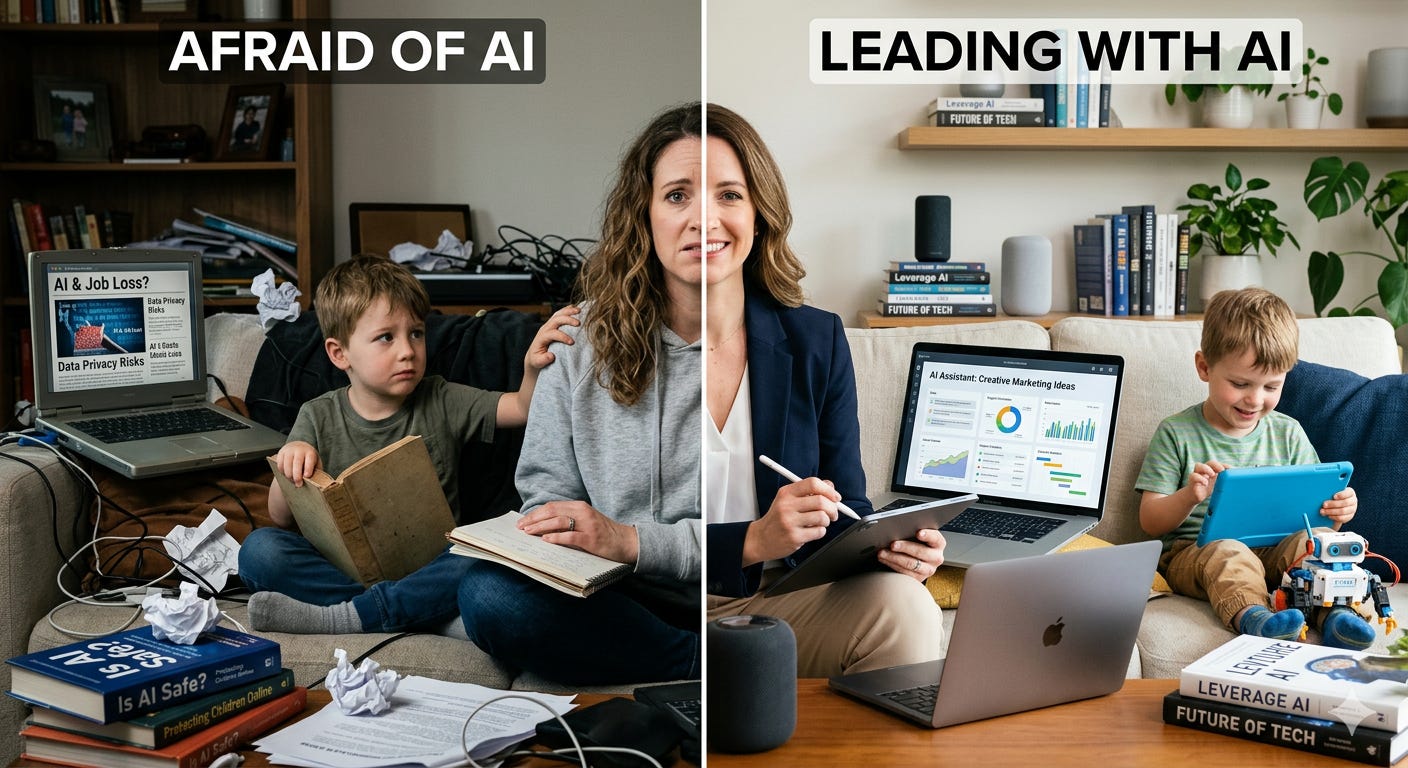
For years, we have been told to fear artificial intelligence. Fear what it will teach our children. Fear what it will replace. Fear what it might become. But the hard truth is this: AI is not raising your kids. Your level of engagement is.
We blame AI.
We blame screens.
We blame algorithms.
We blame “the future.”
We need to step up, put out the effort, and help our kids learn the right way to use technology.
I noticed myself outsourcing too much thinking to AI. Letting it draft. Letting it structure.
If I am not careful, AI doesn’t just support my thinking; it shapes it. It replaces it.
The Real Risk: Cognitive Atrophy
Studies from October 2025, in pmc.ncbi.nlm.nih, find that Generative AI dependency predicts lower academic achievement and false self-efficacy. Overreliance weakens autonomous learning, critical thinking, and analytical thinking.
This means letting generative AI “do the thinking for us” risks weakening human capacities.
Many of these facts are not new. Studies from 2023 showed similar warnings. But nothing has changed. In America, over 60% of adults use AI, 35% report at least weekly use. And this doesn’t account for all those who don’t even realize they are using it.
We cannot wait for the government to protect us from ourselves.
It is up to us to do the hard work. We must be more aware of our own use and
stop making excuses.
AI is a tool. Tools can be used for good or bad.
AI is only as effective as the person using it. If we use it to replace our own thinking—like students who stop learning or parents who stop being curious—we become passive participants in our own lives. This isn’t an argument against using AI; it’s a warning against letting it turn us into unthinking users who have lost the ability to discern for ourselves.
What Does Passive Parenting Look Like?
It looks like handing a child a device without any conversation.
Allowing AI chat companions with no emotional context.
Not understanding the tools kids are using.
Using AI to solve everything instead of modeling thinking.
AI will not raise your child. But it will shape them if you are absent.
The Opportunity We Are Ignoring
Here is what AI can do:
Help moms build businesses faster.
Help with executive functioning.
Help organize chaos.
Help with research, drafting, and planning.
Help kids learn faster when used ethically.
The question is not: Should we use AI?
The question is: Who is leading the interaction?
AI should amplify executive function, not erode it.
Use AI like this:
1. Let AI handle the tedious stuff — scheduling, formatting, summarizing — this reduces mental clutter, which gives you more room to actually think. That’s not laziness. That’s working at the level you’re capable of.
2. If you’ve got a neurodivergent brain, AI isn’t a shortcut. It helps you start, stay organized, and keep moving when your brain wants to do literally anything else. Think of it as the assistant that never judges you for needing a nudge.
3. Here’s the twist: letting AI do more actually requires more brainpower from you, not less. Deciding what matters, adapting when plans shift, making the ethical calls — that’s all you. AI can draft the email. It can’t decide if it should be sent.
What Active AI Leadership Looks Like at Home
For moms:
Ask AI for options, then choose deliberately.
Ask AI to challenge your thinking.
Use AI to draft but refine in your own voice.
Teach your kids to question outputs.
For kids, ask them:
“Why do you think it answered that way?”
“What might it be missing?”
“How would you verify that?”
You are teaching discernment, not avoidance.
The Real Divide is not access. Not intelligence. Not speed.
The divide will be between:
Families who consume AI passively ….
and
Families who lead with it intentionally.
The future will not belong to the families who avoid AI.
It will belong to the families who refuse to surrender their own thinking to it.
Want a place to get more resources, support, and encouragement? Head over to our Raising Digital Natives community. It is completely free, and we talk about all of this and so much more.