
Your Mom Was Scared of the Wrong Thing. So Are You.
What all generations get wrong...

"Your Mom Had No Idea Who You Were Talking To. Neither Do You."
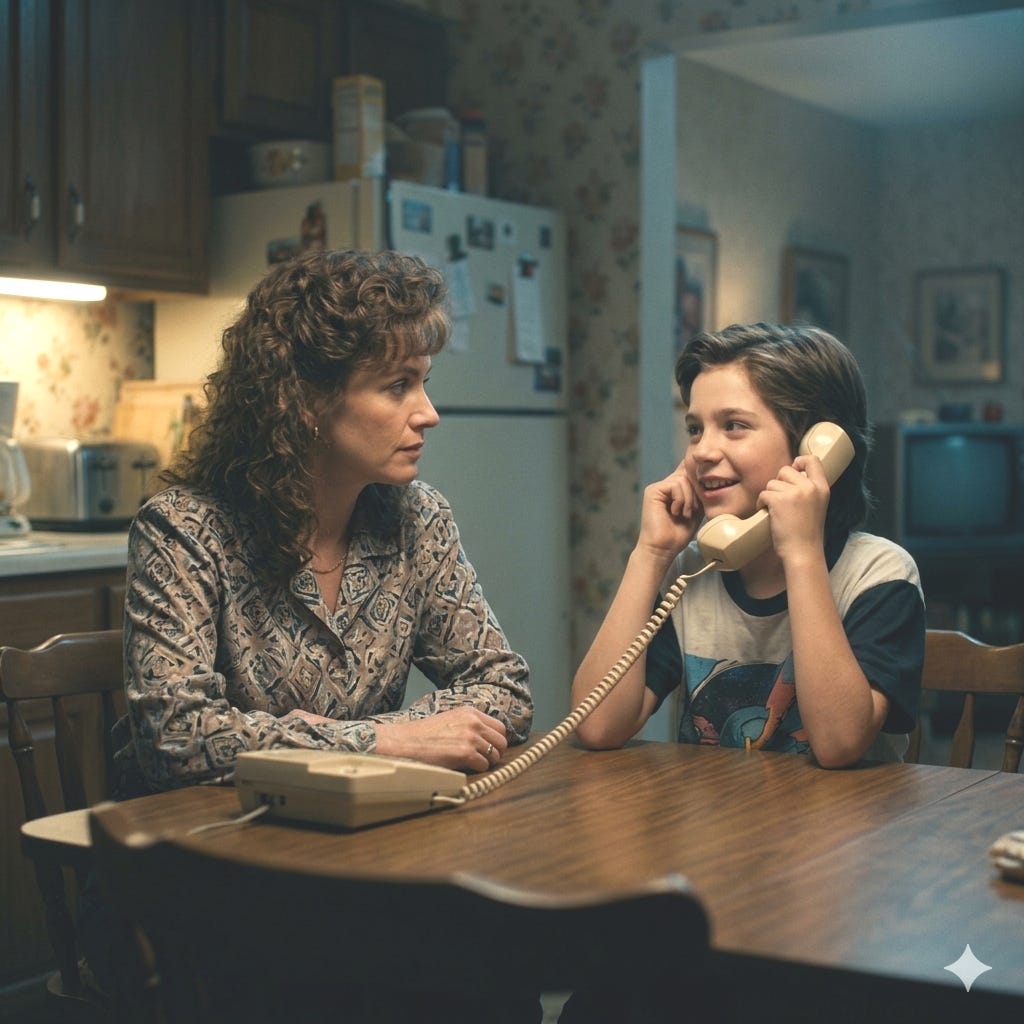
Your mom wouldn’t let you walk to a friend’s house alone. She warned you about strangers in cars, men who offered candy, and talking to people you didn’t know. She meant well. She was also, statistically, worried about the least likely threat in your life.
Now here you are. You’ve installed parental controls, checked your kid’s texts, and Googled “how to keep my child safe online” at 11 pm while eating cereal over the sink. You mean well too.
And you might be making the exact same mistake she did.
The Fear Is Legitimate. The Focus Might Not Be.
Here’s what you and your mom have in common: you’re both responding to the most visible threat, not necessarily the most significant one.
In the 80s and 90s, “stranger danger” was everywhere — on milk cartons, in school assemblies, in every after-school special ever produced. The fear was real. The threat was real. But statistically, the vast majority of harm done to children came from people they already knew — not strangers with candy.
Your mom wasn’t wrong to be careful. She was wrong about where to prioritize.
Fast forward to today. The fear has a new name. Now it’s screen time, predators in DMs, TikTok algorithms, and AI chatbots. And again — the fear is real. The threat is real — but as I explored in “AI Is Not the Threat. Passive Parenting Is” the thing quietly doing the most damage rarely makes the headlines.
But here’s the question worth sitting with: Are you focusing on the most visible threat, or the most significant one?
What the Research Actually Says
Neuroscience has a term for what’s happening in both generations: availability heuristic. It’s a cognitive shortcut your brain uses to assess risk based on how easily an example comes to mind. The more dramatic and memorable a threat is, the more dangerous your brain rates it — regardless of actual probability.
Stranger abductions were terrifying and heavily publicized. So your mom’s brain flagged them as the #1 danger. AI chatbots are terrifying and heavily publicized. So your brain flags them as the #1 danger.
Meanwhile, the quieter, slower, less-headline-worthy threats keep doing their work.
So What’s Actually the Threat?
I’m not here to tell you that online predators aren’t real (they are) or that AI poses zero risk to kids (it doesn’t). What I am here to say is this: the biggest threat to your child’s future isn’t a specific app or platform.
It’s the absence of a thinking framework.
Kids who haven’t been taught how to evaluate information, question sources, recognize manipulation — digital or otherwise — are vulnerable to every threat, not just the ones currently making headlines. And kids who have been taught to think critically? They’re equipped for threats we haven’t invented yet.
Your mom couldn’t have predicted the internet. You can’t predict what comes after AI. But you can raise a kid who knows how to pause, question, and decide — instead of just absorbing and reacting.
That’s not a parenting trend. That’s a cognitive life skill.
The Pattern Worth Breaking
Here’s the generational handoff nobody talks about: reactive fear-based parenting. It looks like this — a new threat emerges, it gets saturation media coverage, parents respond with rules and restrictions, kids learn to route around the rules, and the underlying skill gap stays exactly where it was.
Rinse. Repeat. In every decade.
Your mom’s version had different props. Yours has better Wi-Fi. But the pattern is the same.
Breaking it doesn’t mean being less protective. It means being strategically protective — focused on building your child’s internal compass rather than managing every external variable. Because you can’t block every app. You can’t monitor every conversation. But you can raise a kid who doesn’t need you to.
✨ Kismet Fact: The “stranger danger” campaign, which dominated parenting culture for decades, was later criticized by child safety experts for being largely ineffective — and for actually reducing children’s ability to ask trusted adults for help, because it taught them to fear all unknown people. The overcorrection created its own vulnerability. Sound familiar?
The good news? You don’t have to repeat the pattern. You just have to see it first — and you’re already doing that by reading this.
If you want to be around other parents who are having this exact conversation — parents who are done with reactive panic and ready to parent with actual strategy — come join us in Raising Digital Natives. It’s free, it’s real, and nobody’s selling you a filter app.
👉 facebook.com/groups/raisingdigitalnatives
Hit reply — I actually read every one. Tell me: what’s the online threat that keeps you up at night? I want to know what’s actually on your mind.